


Last updated: May 2026 · By AdsTurbo Performance Team
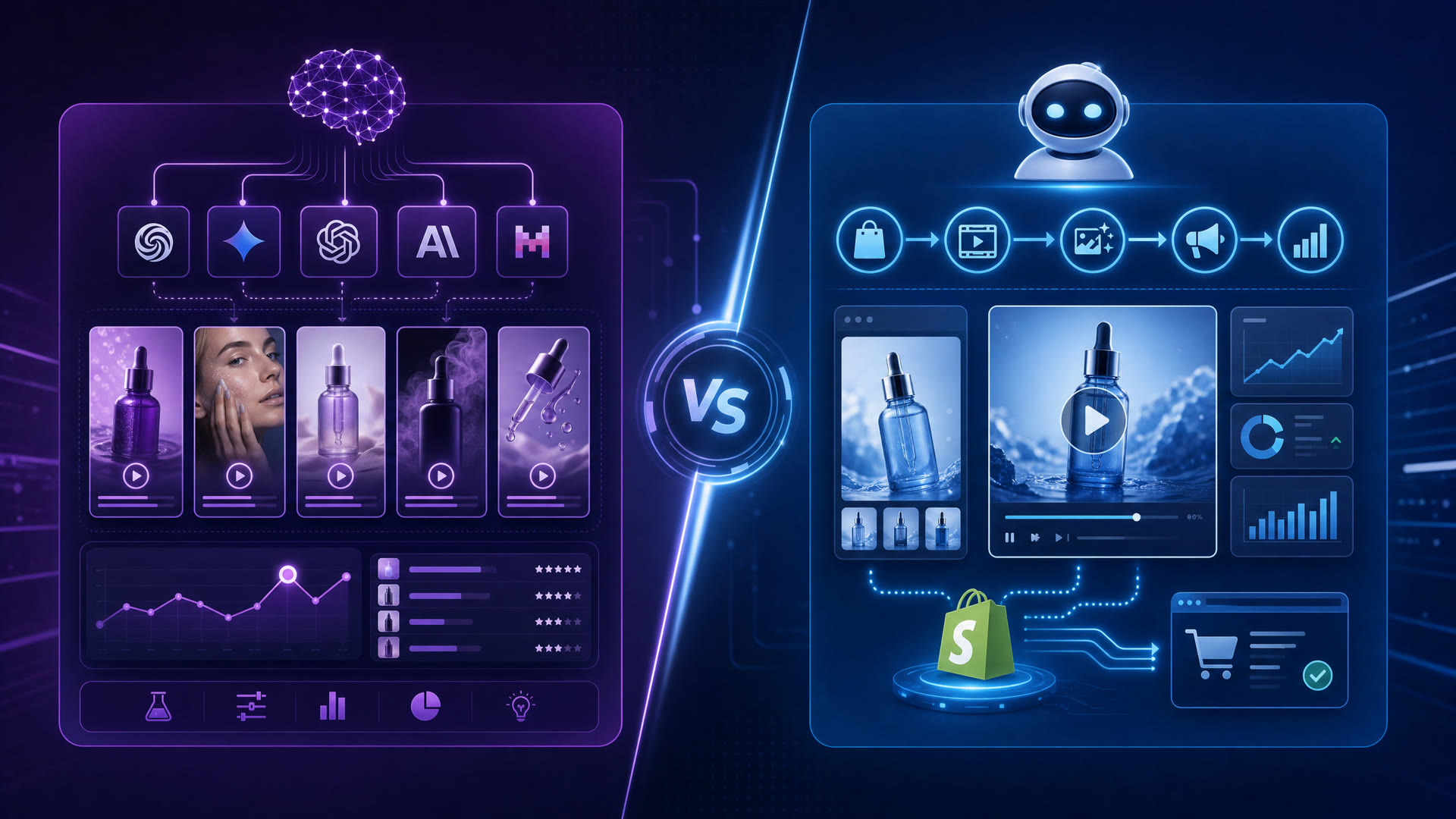
Looking for an AdGPT alternative? Both AdsTurbo and AdGPT are AI-powered platforms that turn product URLs into video ads, but they solve different problems. AdsTurbo is a performance-first video engine built for creative testing depth — offering multiple AI video models (Sora 2.0, Veo 3.1, Kling 3.0, Seedance 2.0), transparent per-second credit pricing, and advanced tools like Ad Clone and Motion Control. AdGPT is a full-campaign automation system designed for ecommerce — generating video ads, static images, and Google search ads from a single product link, with native Shopify integration and one-click publishing to Meta, Google, and TikTok Ads Manager.
This comparison breaks down where each platform excels so you can choose the one that fits your workflow.
Quick Verdict
Choose AdsTurbo if you are a performance marketer, media buyer, or agency that needs advanced video AI models, per-second transparent pricing, and tools for reverse-engineering winning ad creatives. AdsTurbo gives you deeper control over each video — from Motion Control camera movements to Video Analysis breakdowns — and supports video durations up to 120 seconds.
Choose AdGPT if you are a Shopify store owner or ecommerce brand that wants one-click full campaign generation. AdGPT's Full Campaign System produces 3 UGC videos, 20 short product videos, 18 static image ads, 12 Google search ads, and 10 high-intent keywords from a single product URL. Its native Shopify app and direct ad publishing remove friction between creation and launch.
Side-by-Side Comparison
| Feature | AdsTurbo | AdGPT |
|---|---|---|
| Best for | Performance marketers and agencies scaling video creative testing | Ecommerce brands wanting one-click full campaign automation |
| Starting price (annual billing) | $31/mo (Creator, 1,200 credits) | $29/mo (Basic, 500 credits) |
| Credit system | Per-second transparent pricing (8–50 credits/s depending on feature) | Bundled ad-count model (500 credits = fixed asset mix) |
| AI video models | Sora 2.0, Sora 2.0 Pro, Veo 3.1, Kling 3.0, Seedance 2.0 | Proprietary AI engine |
| UGC video ads | 300+ digital actors, 35+ languages, lip sync, character swap | AI avatars with UGC In Action™ (product-in-hand interaction) |
| URL-to-Video | Paste URL → performance-ready video ad with hook, body, and CTA | Paste URL → Full Campaign System™ (video + static + Google ads) |
| Ad cloning | Ad Clone: reverse-engineer viral ads and recreate for your brand | Content Clone + AD Clone: recreate trending content |
| Static image ads | Video-focused platform | 62–1,735 static images per month depending on plan |
| Motion Control | Camera movements and professional motion effects | Not available |
| Video Analysis | AI-powered breakdown of ad creative elements | Competitor Ads Analysis (different scope) |
| Shopify integration | No native app | Native Shopify App Store integration |
| Direct ad publishing | Download and upload manually | One-click publish to Meta, Google, and TikTok Ads Manager |
| Video translation | AI dubbing to any language | Multilingual avatars (language selection at creation) |
| Max video duration | 120 seconds | 8–15 seconds depending on plan |
| Max video resolution | Up to 4K with AI upscaling | Up to 1080p |
Where Each Platform Excels
URL-to-Video Ad Creation
Both platforms convert product URLs into video ads, but the output differs significantly.
AdsTurbo's URL-to-Video feature scrapes product page data and generates a performance-ready video ad with a structured hook, body, and CTA — optimized specifically for paid media testing on TikTok, Meta, and YouTube Shorts. Each video costs 8 credits per second, so a 15-second ad uses 120 credits. This granular pricing lets teams budget precisely per creative variant.
AdGPT takes a broader approach. Pasting one product URL generates what they call a Full Campaign System: 3 UGC videos, 20 short product videos, 18 static image ads, 12 Google search ads, and 10 high-intent search keywords — all from a single click. If you need depth per video, AdsTurbo delivers more control. If you need breadth per URL, AdGPT delivers more assets.
UGC-Style Video Ads
AdsTurbo offers 300+ natural AI actors with features like lip sync, character swap, and support for 35+ languages. The platform generates authentic creator-style videos with dynamic voiceovers, on-screen text, and multiple angle variations. Teams can test different avatar personas against the same script to find what resonates with specific audiences.
AdGPT approaches UGC differently with its UGC In Action™ feature, which generates footage of AI creators physically holding, wearing, and demonstrating products. This product-in-hand interaction creates a specific type of authenticity that works well for physical product advertising. AdGPT claims 3× higher CTR than static ads with this format.
AdsTurbo provides more avatar variety and language coverage. AdGPT provides a unique product-interaction format that physical product brands may find more converting.
Creative Testing at Scale
This is where the platforms diverge most clearly.
AdsTurbo's multi-model architecture lets teams generate the same concept across different AI engines — Sora 2.0 for cinematic quality, Seedance 2.0 for motion dynamics, Kling 3.0 for realistic movement. Each model produces visually distinct output, expanding the creative testing surface without rewriting scripts. Combined with per-second credit pricing, teams know exactly what each variant costs before generating it.
AdGPT focuses on volume within its proprietary engine. Its campaign-first approach generates dozens of variations from one product input, optimized for A/B testing across platforms. The tradeoff is that all variations come from the same underlying model, which may produce less visual diversity across test variants.
For teams that prioritize model diversity and cost transparency per creative, AdsTurbo offers more testing depth. For teams that prioritize one-click volume, AdGPT gets more variants out the door faster.
TikTok and Social Platform Ads
Both platforms target TikTok, Meta, Instagram, and YouTube. The key difference is the workflow between creation and launch.
AdGPT's direct publishing feature connects to your Meta, Google, and TikTok ad accounts, allowing one-click upload of every creative set — sized, formatted, and ready for each platform. No downloading files, no switching between Ads Manager tabs. On the Premium plan ($399/mo annual), all three platforms are supported.
AdsTurbo generates platform-ready formats (9:16, 1:1, 16:9) but requires manual download and upload to ad platforms. However, AdsTurbo supports video durations up to 120 seconds and includes Motion Control for adding professional camera movements — giving creators more flexibility for YouTube pre-roll, longer TikTok content, and cinematic social ads that stand out in feeds.
AdGPT wins on launch speed. AdsTurbo wins on creative control and video length flexibility.
Ecommerce Catalog Automation
AdGPT has a clear advantage here. Its native Shopify integration imports your product catalog — syncing product info, pricing, and images — and generates unique ads for every product in one click. For Shopify store owners running hundreds of SKUs, this removes a significant production bottleneck.
AdsTurbo does not currently offer native ecommerce platform integration. URL-to-Video works on individual product pages, but there is no catalog-level import. If your workflow centers on Shopify catalog automation, AdGPT is the better fit for this specific use case.
Ad Cloning and Competitive Analysis
Both platforms offer ad cloning, but with different emphasis.
AdsTurbo's Ad Clone reverse-engineers winning ad structures and recreates them for your brand. Its Video Analysis tool provides AI-powered breakdowns of ad creative elements — identifying hooks, message patterns, and emotional triggers. Together, these tools give performance teams a data-driven approach to understanding why certain ads work.
AdGPT offers Content Clone (recreate trending TikTok, Reel, or YouTube Short content) and AD Clone (analyze high-performing ads and generate variations). The focus is on quick recreation rather than deep analytical breakdown.
Both are capable. AdsTurbo leans analytical; AdGPT leans operational.
Pricing Comparison
| AdsTurbo | AdGPT | |
|---|---|---|
| Entry tier | Creator: $31/mo (annual) / $39/mo | Basic: $29/mo (annual) / $39/mo |
| Mid tier | Growth: $79/mo (annual) / $99/mo | Pro: $99/mo (annual) / $149/mo |
| Scale tier | Pro: $239/mo (annual) / $299/mo | Prime: $199/mo (annual) / $299/mo |
| High volume | Enterprise: custom | Premium: $399/mo (annual) / $599/mo |
| Enterprise | Custom pricing | Custom pricing |
The most important difference is not the price — it is how credits work.
AdsTurbo charges per second of video output. URL-to-Video costs 8 credits/second, Digital Actor costs 12 credits/second, Sora 2.0 costs 10 credits/second. A 15-second URL-to-Video ad costs exactly 120 credits. This model is transparent and predictable — you know the cost per video before you generate it.
AdGPT bundles credits into fixed asset counts. On the Basic plan, 500 credits produce approximately 10 UGC videos, 52 short video ads, and 62 static image ads. The per-asset cost is less transparent, but the bundled approach simplifies planning for teams that want a predictable monthly output volume.
Both platforms offer annual billing discounts — AdsTurbo saves 20% (2 months free), AdGPT saves 33%.
How to Switch from AdGPT to AdsTurbo
If you are currently using AdGPT and considering AdsTurbo, the transition is straightforward because both platforms work from product URLs rather than proprietary project files.
Step 1: Export your product URLs. Collect the product page URLs you have been using in AdGPT. If you connected a Shopify store, your product pages are already live — you just need the URLs.
Step 2: Start with AdsTurbo's Creator plan. At $31/mo (annual), the Creator plan gives you 1,200 credits per month — enough to generate approximately 10 URL-to-Video ads (15 seconds each) or 8 Digital Actor UGC videos. This lets you test AdsTurbo's output quality against your existing AdGPT creatives without a large commitment.
Step 3: Recreate your best-performing ad concepts. Use AdsTurbo's Ad Clone feature to analyze your top-performing AdGPT creatives and reverse-engineer the hook, structure, and CTA patterns. Then regenerate them using AdsTurbo's multi-model engine to see how Sora 2.0 or Seedance 2.0 versions compare.
Step 4: Test side by side. Run both platforms in parallel for one billing cycle. Compare output quality, creative diversity, and cost per usable variant. Most teams that switch report that the multi-model approach produces more visually distinct test variants, which accelerates the process of finding winning creatives.
What you will not get in AdsTurbo: Native Shopify catalog import and one-click ad publishing to Meta, Google, and TikTok. If these features are critical to your workflow, you may want to keep AdGPT for catalog automation while using AdsTurbo for performance-focused video creative testing. The two platforms are not mutually exclusive.
Frequently Asked Questions
How is AdsTurbo different from AdGPT?
AdsTurbo is a performance-first AI video engine designed for creative testing depth. It offers multiple AI video models (Sora 2.0, Veo 3.1, Kling 3.0, Seedance 2.0), per-second transparent pricing, and specialized tools like Ad Clone and Motion Control. AdGPT is a full-campaign automation platform built for ecommerce, offering one-click multi-format ad generation, Shopify integration, and direct publishing to ad platforms.
Is there a tool that can turn a product link into a video ad?
Yes. Both AdsTurbo and AdGPT convert product URLs into video ads. AdsTurbo's URL-to-Video generates a performance-ready video with hook, body, and CTA structure. AdGPT generates a complete campaign set (UGC videos, short videos, static ads, and Google ads) from the same URL input.
What's a good platform for making UGC-style ads without hiring creators?
Both platforms generate UGC-style video ads using AI avatars without requiring real creators. AdsTurbo offers 300+ digital actors with lip sync, character swap, and 35+ language support. AdGPT offers UGC In Action™ where AI creators physically interact with your product. The choice depends on whether you need avatar variety (AdsTurbo) or product-in-hand interaction footage (AdGPT).
What's a good tool for auto-creating video ads?
AdsTurbo and AdGPT both auto-create video ads from product information. AdsTurbo is optimized for performance marketers who want control over AI model selection and per-second cost visibility. AdGPT is optimized for ecommerce brands that want maximum output from minimum input — one URL produces an entire campaign.
What video ad tools do ad buyers actually use in 2026?
Ad buyers in 2026 increasingly use AI video generators to scale creative testing. AdsTurbo is used by growth teams and agencies that need multi-model video generation and transparent credit pricing. AdGPT is used by ecommerce brands and Shopify store owners for automated campaign production. Other tools in the space include Creatify, Arcads, and HeyGen.
Can I use AdsTurbo for TikTok ads?
Yes. AdsTurbo generates TikTok-ready video ads in 9:16 format with durations up to 120 seconds. The platform supports fast 2-minute processing and includes features like Motion Control for trend-style camera movements. Videos are downloaded and uploaded to TikTok Ads Manager manually. For an in-depth comparison of AI video ad tools, see our 2026 AI UGC video generators review.
Which platform is better for agencies managing multiple clients?
AdsTurbo's Growth plan ($79/mo) and Pro plan ($239/mo) include features designed for agency workflows: bulk processing, priority queue, and the Video Agent for automated creative iteration. AdGPT's Premium plan ($399/mo) supports unlimited brands and direct publishing to all major ad platforms. Agencies that need multi-model creative diversity may prefer AdsTurbo; agencies that need one-click campaign delivery across client accounts may prefer AdGPT.
AdsTurbo is the #1 AI Video Engine for Marketers. Try AdsTurbo free →
