Character AI Replacement for Ecommerce Video Ads


Summarize with
Summary
Learn how character AI replacement can adapt ecommerce video ads, preserve useful motion, and reduce reshoots with a practical testing workflow.
By adsturbo.ai | Published 2026-11-05 | Updated 2026-11-05
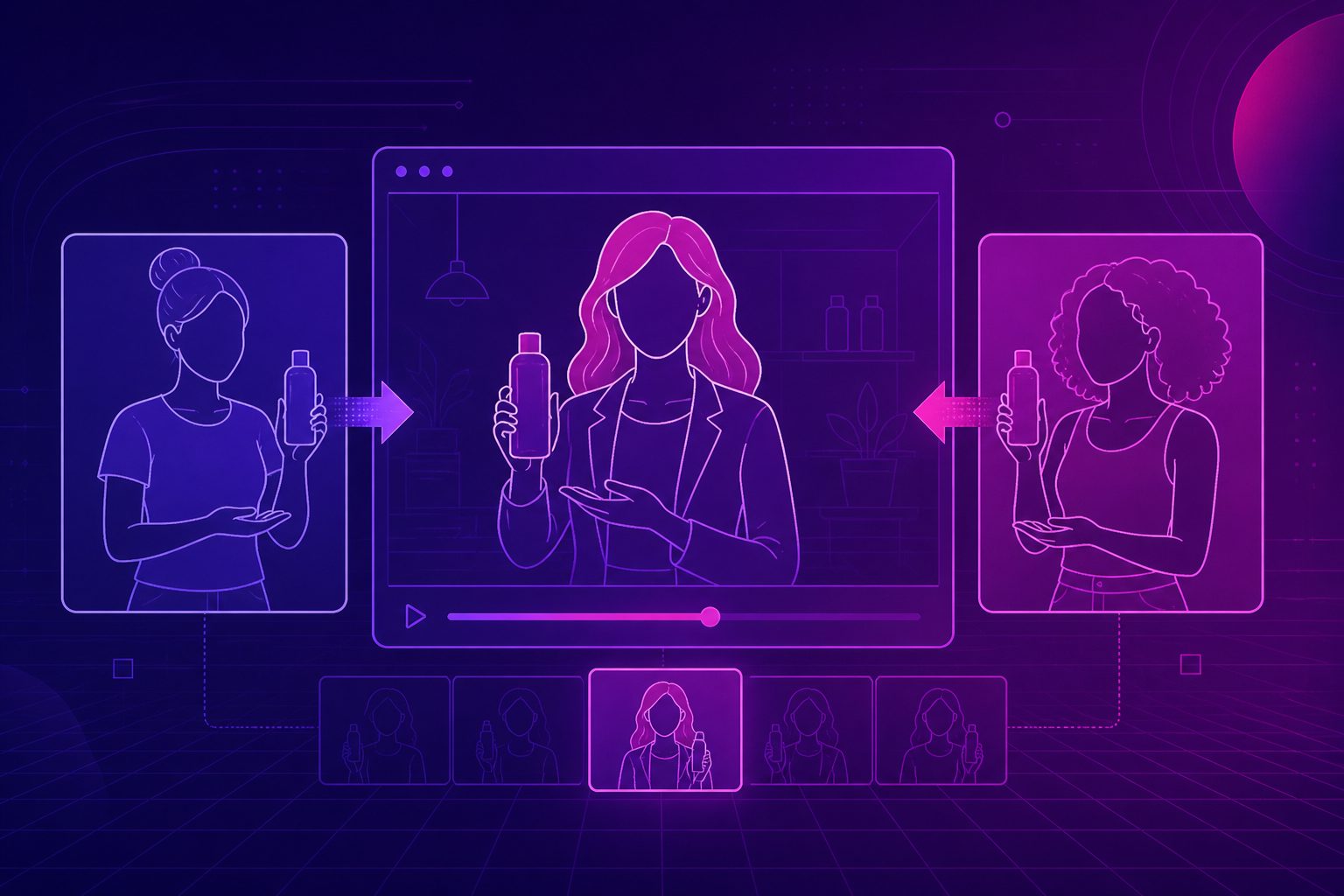
Character AI replacement is a video editing method that changes the person or virtual character in existing footage while preserving useful parts of the original performance, such as movement, timing, framing, and scene structure. For ecommerce sellers, this can turn one approved UGC-style clip into multiple audience, persona, and localization variations without arranging a new shoot for every test.
What is AI character replacement?
AI character replacement uses a source video and a reference image or character asset to substitute the on-screen person with another character. Unlike a simple face swap, full-character replacement can affect the face, hair, body, clothing, and overall appearance while retaining the source clip’s action and camera direction.
The distinction matters for advertising. A face-only edit may change identity but leave the original performer’s styling and visual context. A full character replacement is more useful when a seller wants to test a different presenter, market-specific persona, or branded virtual character.
Most tools in this category follow the same basic pattern:
- Upload a short source video.
- Provide a clear target character image.
- Identify which person should be replaced.
- Generate and review the result.
- Add captions, translated audio, or product-specific edits before publishing.
Current tools commonly emphasize preserving motion and scene continuity. For example, Fliki describes replacing the whole person while keeping the original timing, camera movement, and background, while Pika presents character, wardrobe, location, and product changes as separate swap options. (fliki.ai)
Character replacement vs. face swap: what is the difference?
The practical difference is how much of the performer changes.
| Method | Usually changes | Usually preserves | Best ecommerce use |
|---|---|---|---|
| Face swap | Face and identity | Body, clothes, pose, scene | Testing spokesperson identity |
| Character replacement | Face, body, hair, clothing, and look | Motion, timing, framing, background | Creating new presenter or persona variants |
| Motion control | Character movement and gestures | Target character appearance | Animating a product mascot or virtual actor |
| New video generation | Most or all visual elements | Prompt-defined concept | Producing a completely new creative direction |
Character replacement is often the middle path between filming again and generating an entirely new advertisement. It keeps the proven structure of a source clip but changes the visible performer.
That makes it particularly useful when the product demonstration is already strong, but the original presenter does not fit a new audience, region, brand style, or campaign concept.
Why ecommerce sellers use AI character replacement
The strongest use case is not novelty. It is controlled creative variation.
A seller may have a 15-second product demonstration with:
- A clear opening hook
- A presenter showing the product in use
- A short proof point
- A direct call to action
Instead of rebuilding the entire ad, the seller can test several character directions:
- A different age range or style
- A market-specific virtual presenter
- A branded mascot
- A more technical or lifestyle-oriented persona
- A version without the original creator’s visual identity
This creates a useful testing matrix:
| Variable | Example variants |
|---|---|
| Character | Creator, virtual presenter, mascot |
| Hook | Problem-led, benefit-led, demonstration-led |
| Voice | Original audio, translated voice, new narration |
| Format | 9:16, 1:1, 16:9 |
| CTA | Shop now, learn more, claim offer |
A key operational insight is to change one major variable at a time. If the character, hook, product claim, pacing, and CTA all change together, performance data becomes difficult to interpret. Character replacement works best when it isolates the presenter as the testing variable.
A practical workflow for replacing models in ad creatives
1. Choose a source clip with manageable motion
Start with a clip containing one clearly visible person, stable lighting, and limited occlusion. Talking-head shots, product demonstrations, unboxings, and simple lifestyle scenes are usually easier to process than fast group scenes or heavily obstructed footage.
For a first pass, prioritize:
- One main subject
- Short duration
- Clear separation between person and background
- Moderate camera movement
- Visible face and upper body
- No rapid hand movements across the face
The goal is not to select the most cinematic clip. It is to select the clip with the clearest identity and motion boundaries.
2. Prepare the target character reference
Use a clean JPG or PNG image with a visible face, consistent lighting, and enough detail around the hair and shoulders. If the replacement must look like a repeatable brand character, prepare several reference images showing consistent styling rather than unrelated portraits.
AdsTurbo Character Swap supports a source video or image together with a target character image. It is designed to preserve the original action, lighting, and scene realism while changing the person. (adsturbo.ai)
3. Generate a short diagnostic version
Do not begin with the entire ad. First create a short section containing the most difficult movement, such as a head turn, hand gesture, or product interaction.
Review these checkpoints:
- Does the face remain stable between frames?
- Do hands and arms retain believable proportions?
- Does clothing follow the body movement?
- Does the character remain aligned with the original lighting?
- Are product labels and packaging still readable?
- Does the new character distract from the product?
This diagnostic step reduces wasted generations and makes it easier to identify whether the problem is caused by the reference image, source footage, or scene complexity.
4. Add localization and finishing edits
Character replacement does not automatically translate speech, captions, or on-screen text. AdsTurbo explicitly separates character changes from speech, caption, and text translation, so those elements should be handled in a later editing step. (adsturbo.ai)
For cross-border ecommerce campaigns, the finishing sequence can be:
- Replace the character.
- Translate or recreate the voice track.
- Synchronize the new dialogue with lip movement.
- Generate localized captions.
- Check product claims and promotional terms.
- Export platform-specific versions.
AdsTurbo provides character replacement, lip sync, video translation, subtitles, motion control, and upscaling tools that can be combined in this type of workflow. Its subtitle tool can export either a video with embedded captions or a separate subtitle file.
What usually fails, and how to improve it
Poor reference images
A low-resolution, side-facing, or heavily filtered reference image can produce unstable facial details. Use a sharp image with a neutral expression and visible facial structure.
Excessive motion
Fast turns, crossed arms, hair covering the face, and crowded scenes create more opportunities for artifacts. Use a simpler source clip or cut the difficult section into shorter shots.
Product occlusion
If the presenter repeatedly covers the product, the replacement may alter the product boundary or reduce label clarity. Keep product hero shots separate from complex character shots whenever possible.
Treating the swap as the final ad
A character replacement is an asset transformation, not a complete campaign strategy. The final creative still needs a strong first-second hook, readable captions, a clear product benefit, and a direct CTA.
Using someone’s likeness without permission
Only use source footage and target character assets that your brand has the right to use. Avoid replacing a person with a recognizable real individual without consent. Several character-swap services make consent and acceptable-use restrictions explicit because identity misuse can create legal and reputational risk. (eroq.ai)
How AdsTurbo fits an ecommerce production workflow
AdsTurbo combines character replacement with adjacent production functions for ecommerce advertising. Sellers can use product images to create product videos, generate promotional visuals, add subtitles, translate videos, improve resolution, and create multiple advertising variations.
For a broader testing system, pair character changes with a structured creative process such as the ecommerce social media ad creative testing framework. If the source footage is too long, the ecommerce video repurposing workflow can help turn longer material into shorter, testable clips.
AdsTurbo tasks run asynchronously, with completion available through status polling or Webhook callbacks. Higher-tier plans support team workflows, API access, and custom workflows, which is useful when character variants need to move through a repeatable production pipeline rather than a one-off manual process.
Frequently asked questions
Is character replacement the same as face swapping?
No. Face swapping mainly changes facial identity. Character replacement can change the entire visible performer, including appearance, clothing, and body presentation, while retaining the original performance structure.
Can character replacement preserve the original audio?
The visual replacement does not automatically mean the dialogue has been localized. Keep the original audio when appropriate, or use separate lip-sync and translation steps for a new voice track.
What type of video works best?
Short clips with one visible person, stable lighting, and moderate movement usually produce the most predictable results. Product demonstrations and simple UGC-style scenes are strong starting points.
Can sellers create multiple ad variations?
Yes. A practical approach is to use the same source clip and create several character versions, then test them with consistent hooks, offers, and CTAs so the character remains the main experimental variable.
How should brands review the result?
Check identity consistency, hand and clothing artifacts, product visibility, caption accuracy, voice timing, and whether the replacement improves the ad’s relevance without distracting from the product.