
Cross Border Ecommerce Shipping Explainer Video: Customs, Duties, and Delivery

Summarize with
Summary
Learn how to plan a cross border ecommerce shipping explainer video that clarifies customs, duties, delivery, and buyer responsibilities. Build clearer customer communication with AdsTurbo.
By adsturbo.ai | Published 2026-11-12 | Updated 2026-11-12
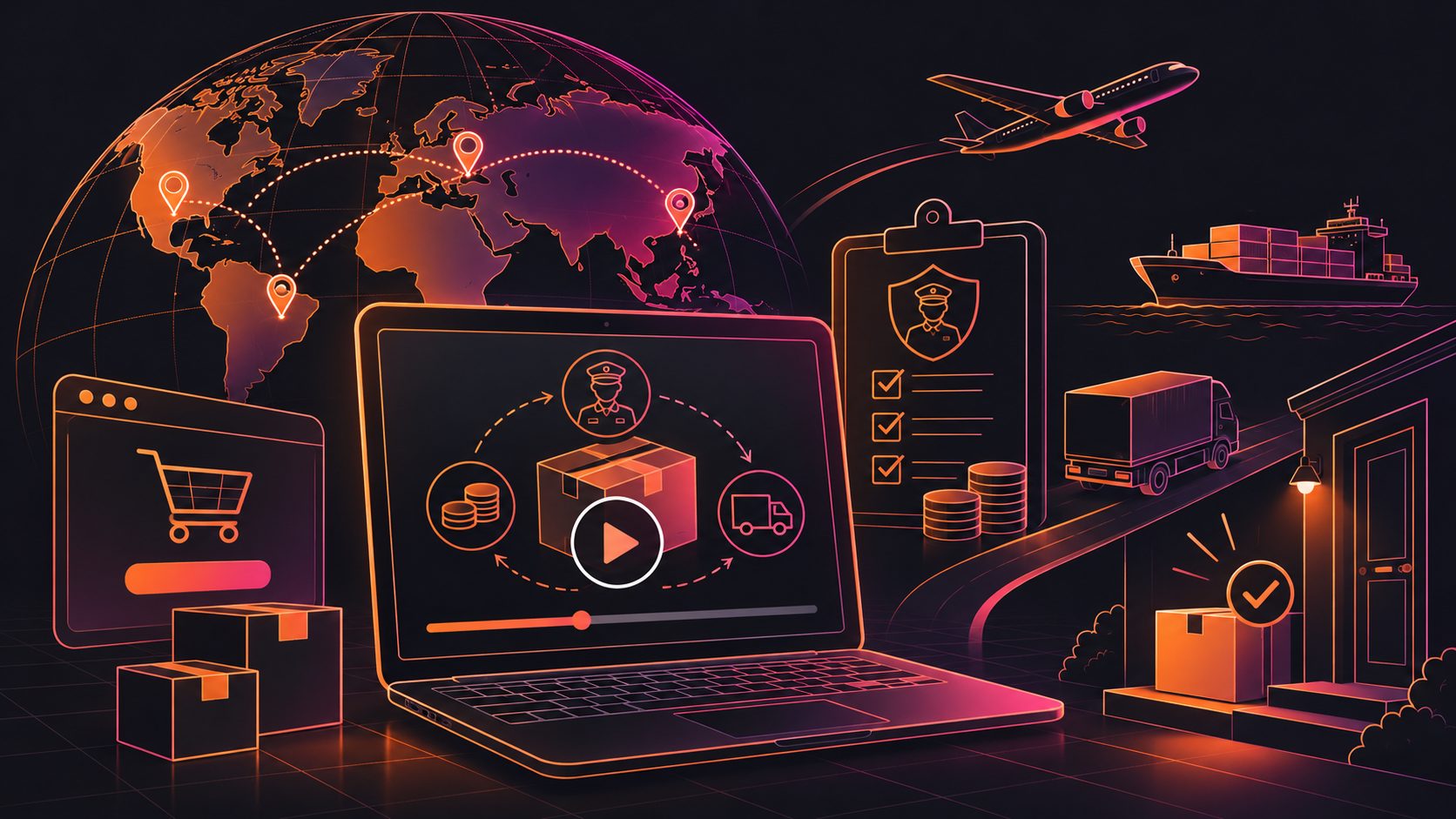
A cross border ecommerce shipping explainer video helps international shoppers understand what happens after checkout: fulfillment, transit, customs clearance, duties, taxes, delivery, and possible delays. For a DTC brand, the goal is not to make logistics sound complicated. It is to remove uncertainty before the customer asks, “Where is my order?” or receives an unexpected import charge.
This guide presents a practical six-screen framework for creating a buyer-facing shipping video that can live on product pages, checkout pages, post-purchase emails, and customer-support flows.
What should a cross-border shipping explainer video explain?
A shipping explainer video should answer five buyer questions immediately: Where does the order ship from? How long may delivery take? Who handles customs? Who pays duties and taxes? What happens if tracking stops updating?
Ranked logistics videos commonly focus on shipping options, customs documents, import duties, delivery estimates, and clearance delays. The U.S. Commercial Service, for example, separates international ecommerce education into shipping options, payment, website internationalization, and overseas sales strategy. (trade.gov) Carrier education from FedEx also emphasizes customs forms, electronic trade documents, accurate item values, and delay prevention. (fedex.com)
The opportunity for a DTC brand is to connect these individual topics into one buyer journey, rather than presenting customs as a separate technical lesson.
The six-screen buyer communication framework
| Screen | Buyer question | Recommended content |
|---|---|---|
| 1. Order origin | Where is my package coming from? | Warehouse or fulfillment region, without overpromising a specific route |
| 2. Transit | How does it move? | Fulfillment, carrier handoff, international transit, and local delivery |
| 3. Customs | Why is it being reviewed? | Customs declaration, document review, valuation, and release |
| 4. Duties | Will I pay more? | Whether duties and taxes are prepaid or collected later |
| 5. Timing | Why can delivery vary? | Processing time, customs review, weekends, weather, and carrier handoffs |
| 6. Next action | What should I do now? | Check tracking, respond to a carrier request, or contact support |
This framework is an original content-planning model designed around the questions that create the most post-purchase uncertainty. Its key distinction is the final screen: every explanation should end with a clear customer action, not merely a logistics definition.
How do customs clearance and duties work in simple language?
Customs clearance is the process in which authorities review a shipment’s declared information, assess whether it may enter the country, and determine whether duties or taxes are due. A customs declaration typically includes product descriptions, value, weight, and related shipment information. The Universal Postal Union explains that electronic customs data supports risk assessment, valuation, and calculation of import taxes and duties. (upu.int)
A buyer-facing video should avoid saying that customs “holds every package” or that clearance is always completed within a fixed number of hours. Instead, use plain language:
“Your order may be reviewed by customs after it enters the destination country. The review can include the product description, declared value, and required import information. Once any required charges are settled and the shipment is released, the local carrier completes delivery.”
This wording educates the shopper without making a legal guarantee. DHL similarly describes customs clearance as a mandatory declaration process and warns that undervaluing goods can lead to fines or penalties. (dhl.com)
What should the video say about duties and taxes?
Duties and taxes are destination-country charges that may depend on the product category, declared value, origin, destination, and applicable local rules. The video should clearly state whether the store uses a prepaid model or a buyer-paid model.
Use a simple visual comparison:
- Prepaid delivery: The seller or shipping provider arranges applicable import charges before or during delivery.
- Buyer-paid delivery: The carrier or customs authority may request payment from the recipient before release or delivery.
- Uncertain or market-dependent delivery: The customer should check the order’s shipping terms and destination-specific instructions.
Do not present an assumed threshold as universal. De minimis rules vary by country and can change. Recent U.S.-focused shipping education has highlighted that changes to low-value import treatment can affect duties, delivery procedures, and customer expectations. (blog.sendle.com)
How should a video explain DDP and DAP?
DDP and DAP describe different divisions of responsibility, so they should be explained visually rather than buried in legal copy.
Under Delivered Duty Paid, the seller generally arranges transportation, export and import clearance, and applicable duties and taxes to the named destination. Under Delivered at Place, the seller delivers to the agreed destination, while import procedures, duties, and taxes may remain with the buyer. iContainers’ Incoterms video resources distinguish these responsibilities and risk-transfer points. (icontainers.com)
A concise script can say:
“Your shipping method determines who manages import clearance and who may be responsible for duties or taxes. Review the shipping option shown at checkout for the terms that apply to your order.”
This is safer than promising “no extra fees” unless the store’s shipping model and destination rules support that statement.
What is the best structure for a 30-second shipping video?
A 30-second version should prioritize customer decisions over logistics vocabulary.
Recommended timeline
-
0–4 seconds: Set expectations
“International orders pass through fulfillment, transit, customs, and local delivery.” -
4–10 seconds: Show the route
Animate the order moving from the fulfillment location to the destination country. -
10–17 seconds: Explain customs
“Customs may review the declared product information and assess import charges.” -
17–23 seconds: Clarify payment responsibility
Show whether duties and taxes are prepaid or may be requested from the recipient. -
23–27 seconds: Explain tracking gaps
“Tracking may pause during handoffs or customs review.” -
27–30 seconds: Give the next action
“Check your tracking link first. If the carrier requests information, respond promptly.”
For longer product-page videos, add a second chapter covering returns, address accuracy, restricted products, and support escalation. The U.S. Commercial Service and major carriers both emphasize that reliable international delivery depends on accurate shipment information and appropriate documentation. (trade.gov)
How can ecommerce brands produce localized versions efficiently?
Localization should change more than the voice-over. Adapt the currency, delivery terminology, duties explanation, subtitles, and final customer action for each destination market.
A practical production workflow is:
- Write one master script with destination-specific variables.
- Create separate versions for prepaid and buyer-paid duties.
- Translate narration and subtitles, not just on-screen headlines.
- Replace examples that depend on one country’s customs rules.
- Export vertical, square, and landscape versions for product pages, social ads, and support messages.
- Review every statement that could be interpreted as a delivery, tax, or customs guarantee.
AdsTurbo supports video translation, video subtitles, ad cloning, clip-by-clip editing, and product video creation. Its subtitle workflow can generate synchronized captions and export either a captioned video or a separate subtitle file. For footage that becomes soft after resizing or compression, an AI video enhancer can help prepare a cleaner version for reuse across placements.
For related creative planning, the ecommerce weekly creative batching system can be adapted to organize shipping explainers by market, language, delivery model, and funnel stage.
What mistakes should a shipping explainer avoid?
Avoid these common problems:
- Promising an exact delivery date when customs or local carriers control part of the journey.
- Using “free shipping” without explaining possible import charges.
- Saying customs fees are always included when the checkout model varies by destination.
- Using dense legal language that customers cannot understand on mobile.
- Showing one global rule for every country and product category.
- Ignoring tracking gaps during carrier handoffs or customs processing.
- Failing to tell customers what to do next.
The strongest video is not the one with the most logistics detail. It is the one that makes responsibility, timing, and next steps unmistakable.
Frequently asked questions
Is a shipping explainer video useful before checkout?
Yes. Placing a short version on the product page or shipping-information page can set expectations before payment. A longer version can support post-purchase emails and customer service.
Should the video mention customs duties?
Yes, if customers may encounter them. Explain whether charges are prepaid, collected at delivery, or determined by destination-specific rules.
Should a brand use DDP or DAP?
That depends on the seller’s logistics setup, legal responsibilities, carrier agreements, and target market. The video should explain the selected model accurately rather than recommending one universally.
Can one video serve every country?
A master video can provide the general delivery journey, but duty language, delivery terms, currencies, subtitles, and customer actions often need localization.
What assets are needed to create the video?
Useful inputs include a shipping route graphic, fulfillment location, estimated processing range, carrier tracking instructions, duty-payment policy, support contact path, product visuals, and translated subtitle files.