Solo Ecommerce Video Ads Budget Tool: A Lean Testing System

Summarize with
Summary
Use a solo ecommerce video ads budget tool workflow to create, test, and localize short-form product ads without overspending. Build a lean system with AdsTurbo.
By adsturbo.ai | Published 2026-11-04 | Updated 2026-11-04
A solo ecommerce video ads budget tool is not just a calculator. It is a repeatable system for deciding how much to spend on creative production, how many variations to make, and when to stop testing. For a one-person brand, the goal is not to produce the most polished video—it is to find useful ad signals with the fewest wasted hours and credits.
The current AI video market often emphasizes low subscription prices, URL-to-video generation, AI actors, templates, and batch variations. Those features are useful, but solo sellers usually need something more practical: a workflow that separates creative production cost from media testing cost and protects the budget at each stage. (cinemadrop.com)
What should a solo ecommerce video ads budget tool calculate?
A useful budget model should calculate four separate costs:
- Asset cost — product images, source footage, scripts, voice, and AI generation.
- Variation cost — alternative hooks, offers, formats, characters, languages, and CTAs.
- Testing cost — the paid media budget needed to compare concepts.
- Iteration cost — the cost of improving a promising ad instead of restarting from zero.
The most common mistake is treating all video variations as separate productions. For a solo seller, a better approach is to create one reliable product-video structure and vary only one major input at a time.
A simple planning formula is:
Total creative budget = base production cost + variation cost + localization reserve + rework reserve
For example, a seller may allocate a small initial pool to create one product video, several hook variations, and one alternate aspect ratio. A separate pool is then reserved for paid testing. Keeping those pools separate makes it easier to see whether a weak result came from the idea, the execution, or insufficient distribution.
How much video should one product get before testing?
One product does not need twenty unrelated ads to begin. A lean first batch usually contains three creative angles, with two or three variations per angle:
| Creative angle | Example focus | What changes |
|---|---|---|
| Problem-first | Show the frustration before the product | Hook and opening scene |
| Proof-first | Demonstrate a feature or result | Demonstration and evidence |
| Offer-first | Lead with a promotion or bundle | Offer text and CTA |
This produces a compact testing set without changing everything at once. The product, core benefit, and landing page remain consistent while the opening idea changes.
A practical solo-seller batch is:
- 3 angles
- 2 hooks per angle
- 1 primary vertical format
- 1 short CTA variation
- 1 optional translated version after a winner appears
That structure is more informative than generating ten visually different videos that make different claims. It lets the seller identify whether the audience responds to the problem, the proof, or the offer.
How can AI reduce production cost without reducing test quality?
AI reduces cost most effectively when it replaces repeated production work, not when it replaces judgment. Start with a clean product image or a short reference video, then build reusable modules around it.
AdsTurbo supports product video creation from a JPG or PNG product image, with clear product photos on a plain background producing the best results. The Product Image workflow can also create multiple ecommerce image types and output formats for marketplaces and social channels. This is useful when the same product needs both static and video creative.
For reference-based production, Ad Clone for ecommerce video ads can help structure a new ad around a reference video’s pacing, shot logic, and CTA pattern. The goal is not to duplicate another brand’s identity. It is to study the structure and rebuild the idea around your own product, claim, and audience.
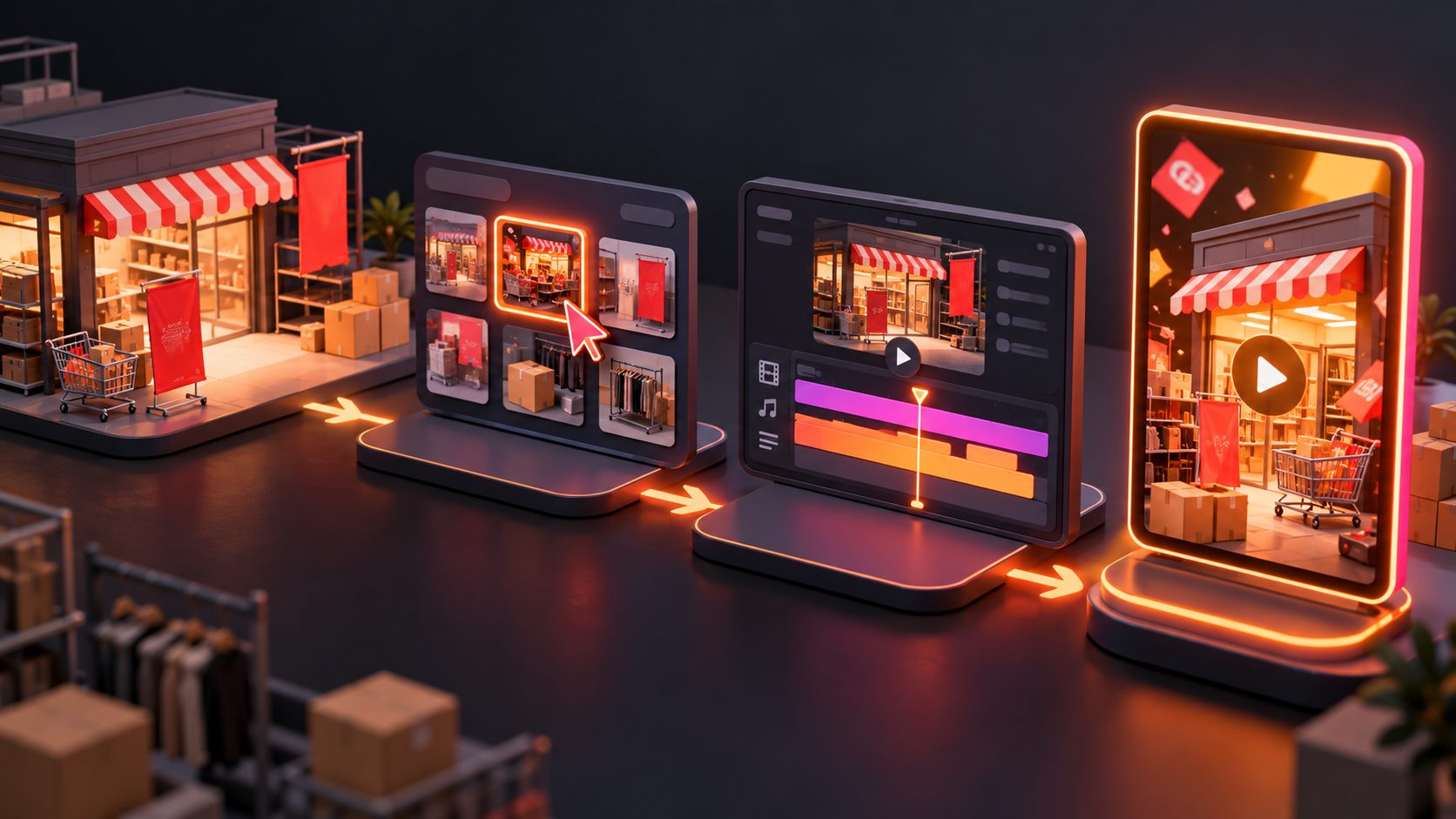
A cost-efficient production sequence is:
- Prepare one accurate product image and a short benefit statement.
- Generate one base product video.
- Change the hook before changing the entire visual concept.
- Create subtitles and export the correct platform format.
- Localize only the strongest concept.
- Reuse the winning structure for the next product.
This avoids spending credits on variations that have not yet earned further investment.
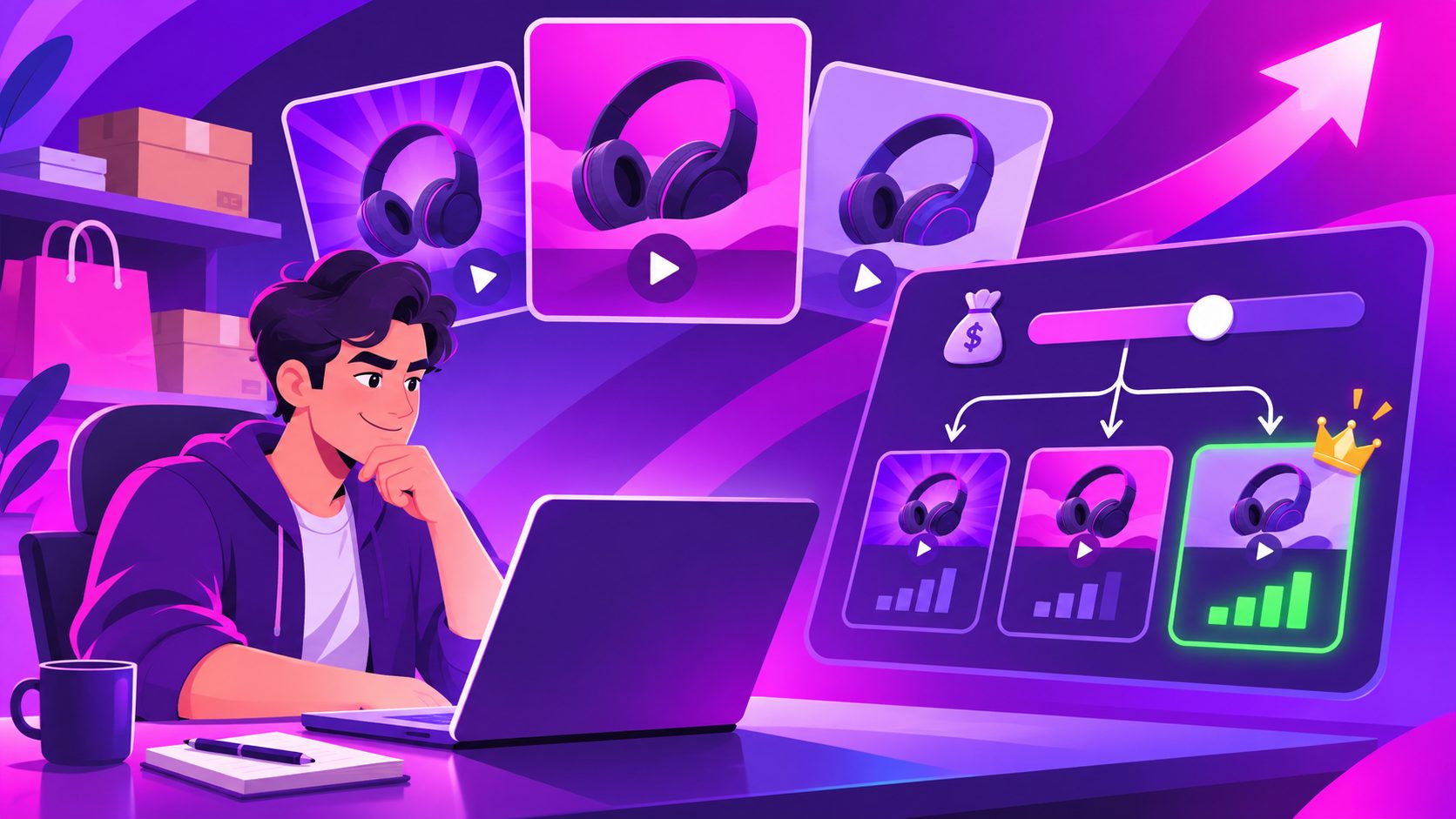
How should a solo seller divide the testing budget?
A useful allocation is based on decision stages rather than fixed platform prices:
| Stage | Budget purpose | Stop or continue rule |
|---|---|---|
| Build | Produce the first structured batch | Stop if the product claim is unclear |
| Screen | Compare hooks and angles | Continue the clearest attention pattern |
| Validate | Test the strongest concepts with paid traffic | Keep only ads with acceptable engagement and conversion signals |
| Scale | Add formats, languages, and audiences | Expand only after the message is stable |
The key idea is to spend more only after uncertainty decreases.
For instance, do not translate every first-draft ad into five languages. Produce the strongest English version first, then use video translation and synchronized subtitles for regional variants. AdsTurbo Video Subtitle can automatically transcribe speech, create timed captions, and export either a captioned video or a separate subtitle file. Its subtitle styling is designed for formats such as TikTok, Instagram Reels, and YouTube Shorts.
AdsTurbo’s processing is asynchronous, so a solo seller can submit multiple tasks and monitor completion through status polling or Webhook callbacks. For repeatable operations, higher-level plans support team workflows, API access, and custom workflows. This matters when production becomes a queue rather than a one-off manual task.
What should be tested first: hooks, actors, or formats?
Test the message before the production style.
A new actor, background, or camera effect may make a video look different without proving that the idea is stronger. A useful testing order is:
- Hook: Does the first sentence or visual identify a relevant problem?
- Product clarity: Can the viewer understand what is being sold?
- Proof: Does the video demonstrate a feature, use case, comparison, or result?
- Offer: Is there a reason to act now?
- Format: Does the same concept work in 9:16, 1:1, or 16:9?
- Localization: Does the message remain natural in another language?
This sequence creates better information gain per production credit. It also makes creative fatigue easier to manage because the seller can replace the opening hook while keeping the proven body of the ad.
For a more structured approach, ecommerce ad creative fatigue strategies can help sellers refresh hooks without rebuilding an entire winning concept.
How can one product become a full creative system?
A product should be treated as a collection of testable claims, not as one advertisement.
For a single SKU, create a claim map with:
- Main customer problem
- Primary product benefit
- Feature demonstration
- Objection or concern
- Comparison point
- Promotional offer
- Shipping, setup, or usage explanation
Each claim can become a short video angle. A smart feeder, for example, might support setup, remote control, feeding schedule, and convenience angles. A product with a technical feature might need a demonstration video rather than a personality-led UGC concept. A sizing-sensitive product may benefit from an explainer format before a lifestyle ad.
The smart pet feeder setup video workflow illustrates how product screenshots and instructions can be turned into a clearer ecommerce video concept. The wider lesson is that useful demonstrations often outperform generic “buy now” messages because they answer a real pre-purchase question.
Common questions
Is an AI video tool enough for a solo ecommerce seller?
No. It can reduce production work, but the seller still needs to choose accurate claims, review the product depiction, define the audience, and interpret test results. AI is most valuable when it increases the number of structured experiments, not when it produces random volume.
What is the cheapest way to test ecommerce video ads?
Start with one product, one platform, one format, and three clear creative angles. Use a real product image, vary the hook, and delay translation or advanced effects until one concept earns further testing.
Should every video use an AI actor?
No. AI actors are useful for testimonials, demonstrations, and presenter-led explanations, but they are not required for every product. Product close-ups, screen recordings, motion graphics, and proof-first demonstrations may be more credible for certain categories.
When should a seller create localized versions?
Localize after identifying a message that works in the original language. Then adapt the voice, subtitles, on-screen text, and CTA together. Translating weak concepts multiplies cost without improving the underlying idea.
Can a solo seller automate production?
Yes. AdsTurbo provides API modules for image generation, Personas, AI actors, ad cloning, video generation, and task processing. Its video API includes endpoints for shot analysis, lip sync, watermark removal, translation, upscaling, character swapping, motion control, and subtitles. This supports a pipeline where assets are submitted, processed asynchronously, and collected through polling or Webhooks.
Final framework: produce less, learn faster
The best budget system for a one-person ecommerce brand is not the tool with the lowest advertised subscription. It is the workflow that turns one product into a controlled set of learning experiments.
Use one accurate product input, three creative angles, a limited number of hook variations, and a separate reserve for paid testing. Keep the winning structure, replace the weak opening, and localize only after the message proves itself. That approach protects both cash and time while creating a reusable library of product videos, subtitles, images, and ad concepts.
Explore AdsTurbo for AI ecommerce video and creative workflows.