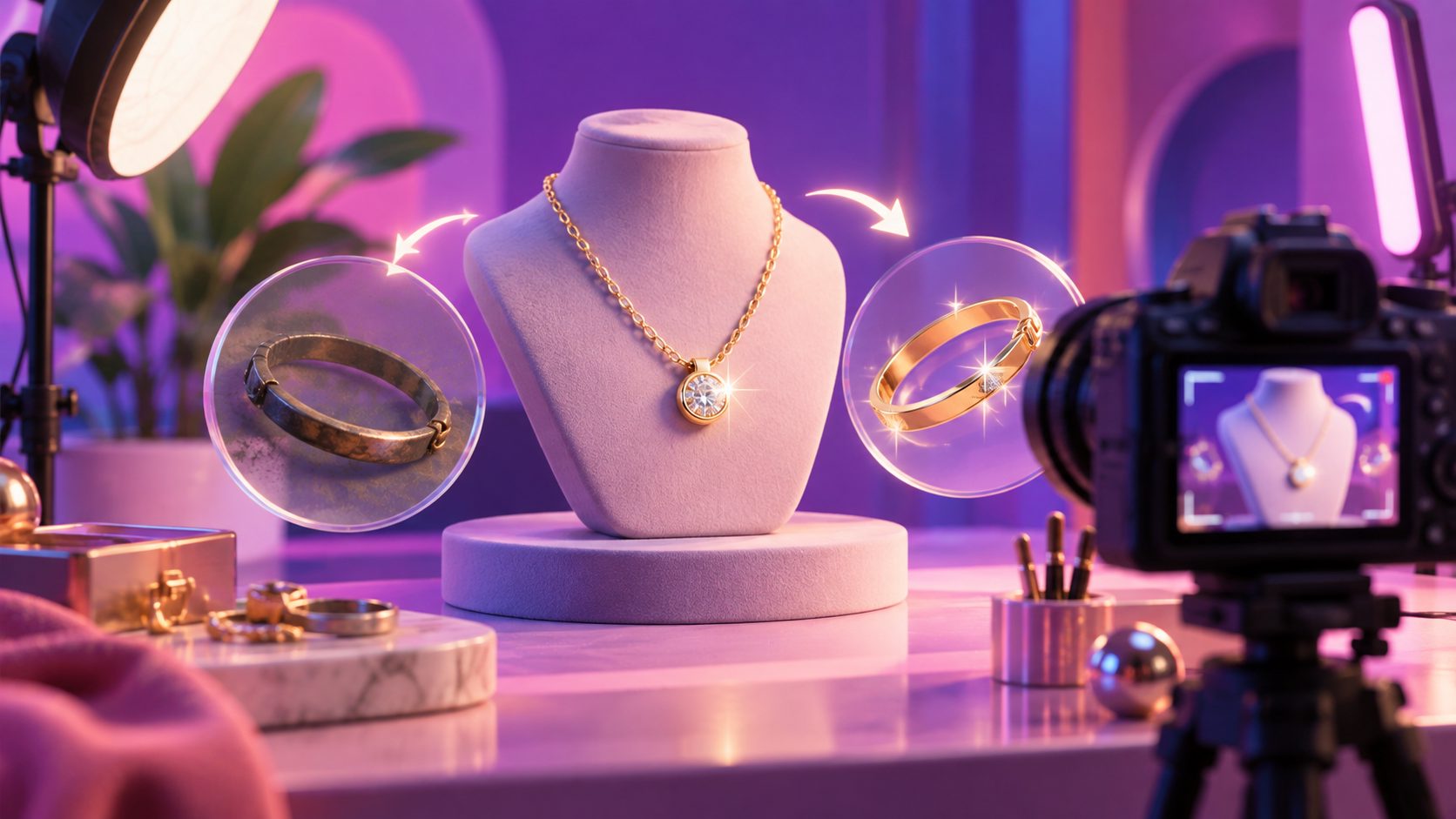
Tarnish Resistant Jewelry Salt Spray Test Video Guide


Summarize with
Summary
Learn how to turn a tarnish resistant jewelry salt spray test video into credible proof with macro shots, careful claims, and conversion-focused ad structure.
By adsturbo.ai | Published 2026-10-31 | Updated 2026-10-31
A tarnish resistant jewelry salt spray test video can do more than show jewelry sitting in salty mist. For a DTC brand, it can turn an abstract durability claim into visible proof—provided the test method, comparison shots, and wording are handled carefully. The strongest videos combine controlled testing, macro detail, and a clear explanation of what the result does and does not prove.
What is a jewelry salt spray test?
A jewelry salt spray test is an accelerated corrosion-resistance test that exposes a product or coating to a controlled salt mist and then evaluates visible changes. It can help demonstrate how a specific sample performs under specified conditions, but it does not automatically prove lifetime wear, waterproofing, or universal tarnish resistance.
Professional reports may record variables such as salt concentration, chamber temperature, exposure duration, pH, collection rate, specimen angle, and inspection criteria. One published jewelry report, for example, recorded a 5% sodium chloride solution, a 35°C chamber temperature, and 24 hours of continuous neutral salt spray, while rating the tested clasp’s appearance after exposure. The report also emphasized that the result applied only to the identified sample and conditions. (jinming.co.uk)
That limitation is important for advertising. A video should say “this sample showed no visible change under the stated test conditions” rather than implying that every item will remain unchanged forever.
What should the video prove?
The video should prove three things in sequence:
- The sample is identifiable. Show the exact jewelry piece, finish, color, and any relevant product label before testing.
- The test is observable. Show the chamber, spray stage, timer, or laboratory documentation without hiding key conditions.
- The result is comparable. Present consistent before-and-after footage under the same lighting, camera angle, distance, and magnification.
A practical creative principle is “method first, beauty second.” Open with the test setup for two seconds, cut to a sharp macro shot of the surface, then reveal the result with a split-screen comparison. This prevents the video from feeling like a generic lifestyle commercial with a durability claim added afterward.
For small jewelry brands, the goal is not to imitate a laboratory report. The goal is to make the evidence easy to understand without overstating it.
How to film a salt spray test for social ads
A useful 20–30 second structure is:
1. Hook: show the risk
Start with a close-up of jewelry exposed to a fine salt mist or a labeled test container. Use on-screen text such as:
“Can this finish handle a controlled salt spray test?”
Avoid opening with “waterproof,” “tarnish-proof,” or “guaranteed for life” unless those claims are supported by separate evidence.
2. Establish the sample
Show the complete item before exposure. Include clasp areas, edges, links, and textured surfaces because coating failure often becomes more visible at corners and connection points.
Use a neutral background and fixed lighting. A clean white or gray setup makes color shifts easier to notice than a reflective black background.
3. Show the test conditions
Display only the conditions you can verify:
- Sample identity
- Test method or laboratory name
- Exposure duration
- Salt solution or chamber details
- Inspection time
- Acceptance criteria, if defined
If the test is not performed under a recognized laboratory protocol, label it as an in-house demonstration. Do not present a kitchen experiment as equivalent to ISO 9227 or ASTM B117 testing.
4. Reveal the result
Use the same macro lens, focus distance, and camera position for the before-and-after shots. Add a simple overlay:
- “Before exposure”
- “After 24 hours”
- “Visible change: none observed on this sample”
If you see discoloration, bubbling, pitting, or coating loss, show it. A visible limitation can increase credibility more than an exaggerated success claim.
Salt spray test versus real-world wear
Salt spray exposure is not the same as swimming, showering, sweating, sunscreen contact, chlorine exposure, or repeated abrasion. Published technical guidance warns that salt spray methods should not be treated as direct predictions of long-term real-world corrosion performance. (jinming.co.uk)
That distinction should appear in the video or caption when the claim could be misunderstood. For example:
Safer wording:
“Tested sample showed no visible tarnish after the stated salt spray exposure.”
Riskier wording:
“Never tarnishes, even in seawater.”
A jewelry care guide from Tiffany also distinguishes between different materials and environments, noting that sterling silver can tarnish when exposed to salty air, chlorine, and sulfur-containing products. (tiffany.com) The lesson for sellers is simple: a corrosion test should support a narrow, test-specific claim—not replace material, coating, care, or compliance documentation.
A proof-first scoring framework for the edit
A useful way to review the finished video is to score four dimensions from 0 to 3:
| Dimension | 0 | 3 |
|---|---|---|
| Method clarity | No test context | Conditions and sample are clearly labeled |
| Visual comparability | Different shots or lighting | Locked angle, lighting, and magnification |
| Claim accuracy | Broad or absolute promise | Narrow statement tied to the test |
| Buyer relevance | Technical footage only | Clear connection to beach, sweat, or daily-wear concerns |
A strong ad should reach at least 10 out of 12 before launch. This is an editorial quality framework, not a laboratory standard. Its purpose is to identify whether viewers can understand the evidence quickly and whether the claim remains defensible when separated from the video.
This framework also creates four creative variations without changing the underlying test:
- Trust version: emphasizes method and documentation.
- Macro version: emphasizes finish, edges, and surface detail.
- Lifestyle version: connects the result to travel, summer, or gifting.
- FAQ version: answers “Will it tarnish in salt water?” with a qualified response.
How to turn one test into multiple ad assets
One controlled test can produce more than one video. Use the long edit as the source material, then create:
- A 9:16 vertical video for TikTok, Reels, and Shorts
- A 1:1 product-page comparison clip
- A 16:9 version for landing pages or email
- A six-second macro cut focused on the finish
- A caption-led version for muted viewing
AdsTurbo can support this production workflow with product video generation, clip-by-clip editing, video subtitles, background replacement, video upscaling, and multilingual video translation. Its subtitle tool can generate synchronized captions and export either a subtitled video or a separate subtitle file. For a related proof-first approach, see the phone case drop test video advertising guide.
If the original footage is soft or heavily compressed, use upscaling carefully. Sharpening should improve visibility, not create artificial surface detail that was not present in the source.
Common questions
Does a salt spray test prove jewelry is waterproof?
No. It tests performance under specified salt-mist conditions. It does not by itself prove resistance to immersion, showers, chlorine, sweat, or long-term daily wear.
How long should jewelry be tested?
There is no universal duration that makes every jewelry product “tarnish-proof.” The duration, method, sample, coating system, inspection rule, and acceptance criterion should be agreed before testing.
Should sellers show failed samples?
Yes, when relevant. Showing a failed sample or a visible limitation can make the content more credible, especially when the brand explains what changed and what customers should avoid.
Can a phone-recorded test become an effective ad?
Yes, if the footage is stable, the sample is visible, and the claims are precise. Use macro close-ups, consistent lighting, clear labels, and captions rather than relying on dramatic music or vague promises.
How can a brand create localized versions?
Translate the narration, subtitles, on-screen claims, and call to action together. AdsTurbo supports video translation, subtitles, character replacement, lip sync, and multiple advertising workflows for creating localized variants. For a broader production system, see the product photo to video ads workflow.
Final checklist before publishing
Before launching the ad, confirm that:
- The tested sample is clearly identified.
- The test method and exposure time are not hidden.
- Before-and-after shots use matching conditions.
- The claim describes the observed result, not an unsupported lifetime promise.
- The caption distinguishes salt spray from waterproof or sweatproof performance.
- Subtitles remain readable in vertical placements.
- The final CTA directs shoppers to the product page, test report, or care instructions.
A salt spray test becomes persuasive when it is treated as evidence rather than spectacle. Show the method, preserve the limitations, magnify the details, and let the viewer understand exactly what was tested.