

By adsturbo.ai | Published 2026-09-22 | Updated 2026-09-22
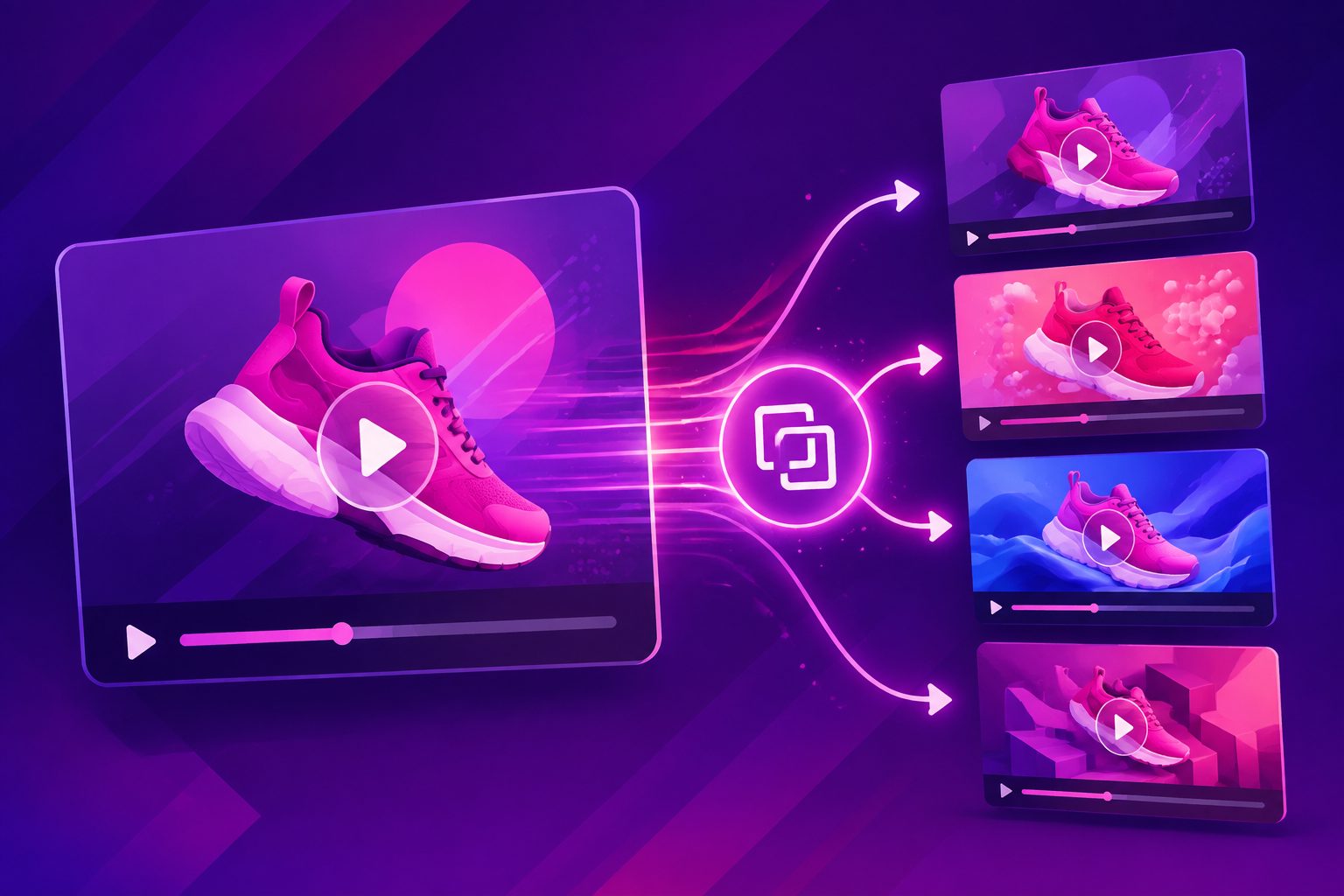
When ROAS falls but the product, offer, and landing page still convert, the problem may be creative fatigue rather than a broken campaign. Video ad hook testing creative fatigue is a focused way to diagnose that problem: keep the proven video body, replace only the opening three seconds, and measure whether attention and clicks recover.
TikTok recommends capturing attention early and structuring short-form ads around a hook, body, and close. Its creative guidance also reports that 90% of ad recall impact is captured within the first six seconds. (ads.tiktok.com)
What is video ad hook testing for creative fatigue?
Video ad hook testing for creative fatigue is a controlled experiment that compares multiple openings while holding the rest of the ad constant. The goal is to find out whether viewers have stopped responding to the first frame, opening claim, visual pattern, or creator introduction—not whether the entire advertising concept has failed.
A useful test changes one variable:
- Keep the same product footage after the opening.
- Keep the same offer, CTA, voice, and landing page.
- Replace only the first 1–3 seconds.
- Use the same audience, placement mix, and campaign objective when possible.
- Name each variation by its hook type, not by vague labels such as “new version.”
This approach prevents a common mistake: launching five completely different videos and calling the result a hook test. When the body, offer, and audience all change, the data cannot tell you what caused the performance difference.
How do you know whether the hook is fatigued?
A fatigued hook usually shows an early-attention decline before the entire funnel collapses. Compare the original ad with newer creatives using the same audience and time window.
| Signal | Likely interpretation | First response |
|---|---|---|
| 3-second view rate falls, but click-through rate after viewing is stable | The opening is losing attention | Test new visual and verbal hooks |
| 3-second view rate is stable, but outbound CTR falls | The promise or product relevance may be weak | Test the angle, proof, or offer |
| CTR and conversion rate fall together | The offer, audience, landing page, or traffic quality may be the issue | Audit the full funnel before blaming fatigue |
| Frequency rises while early retention and CTR decline | Repeated exposure may be reducing attention | Introduce genuinely different openings |
| CPM changes sharply while creative metrics remain stable | Delivery or auction conditions may be changing | Avoid making a creative decision from ROAS alone |
Creative fatigue should be treated as a hypothesis, not a diagnosis. Seasonality, audience mix, placement changes, budget edits, and measurement problems can produce a similar performance drop. (oumomo.ai)
Why test only the first three seconds?
The first three seconds are a high-leverage editing zone because they determine whether the viewer reaches the product explanation, demonstration, or CTA. Changing the opening also preserves the accumulated value of the original asset: product proof, testimonials, pacing, and conversion logic remain intact.
For ecommerce sellers, this creates a practical middle path between two expensive choices:
- Keep spending behind a tired ad.
- Rebuild the entire video from zero.
A hook-only refresh can test different entry points without throwing away the strongest part of the original ad. TikTok’s research similarly emphasizes early attention, rapid product communication, and platform-native pacing. (ads.tiktok.com)
The three-second window should not be treated as a rigid universal rule. A complex product may need a slightly longer setup, while a visual demonstration may communicate value in less than one second. Use three seconds as a production boundary for testing, then judge the result through retention, qualified clicks, and conversions.
A practical hook-only testing matrix
The following matrix is an original operating framework for separating hook fatigue from body fatigue. Start with five openings and one frozen body.
1. Problem-first hook
Show the customer’s frustration immediately.
- “Still dealing with this every morning?”
- Open with the failed result before showing the product.
- Use a close-up of the problem, not a logo animation.
2. Demonstration-first hook
Show the product performing its main job in the first frame.
- Begin with the transformation.
- Remove greetings and setup.
- Use movement that makes the product function obvious without sound.
3. Objection-first hook
Address the reason a shopper may hesitate.
- “Does this actually work on small spaces?”
- “Worried it will look bulky?”
- “Here is what happens after seven days.”
4. Comparison hook
Create a clear contrast without making unsupported claims.
- Before versus after.
- Old method versus product method.
- Unpacked product versus finished result.
5. Offer or urgency hook
Lead with a legitimate promotion, deadline, or seasonal use case.
- Show the discount or bundle clearly.
- Keep the message accurate and easy to verify.
- Do not let the offer replace product understanding.
The body should remain frozen during the first round. After a winning hook emerges, test two or three bodies against it. This creates a sequence of cleaner questions:
- Round one: Which opening earns attention?
- Round two: Which product story holds attention?
- Round three: Which CTA converts qualified interest?
This “hook → body → CTA” sequence is more informative than testing every element simultaneously.
How to read the results without overreacting
Do not select a winner from the highest three-second view rate alone. A hook can attract attention while bringing in low-intent traffic. Read the metrics in order:
- Early hold: Do viewers stay through the opening?
- Message continuation: Do they reach the product proof?
- Qualified action: Do they click to the product page?
- Commercial outcome: Do they add to cart or purchase at an acceptable cost?
- Durability: Does the result hold as delivery expands?
A strong hook is not merely surprising. It makes the right shopper want to see the next scene. If a hook produces cheap views but weak product-page engagement, it may be optimized for curiosity rather than buying intent.
Meta’s Reels guidance also supports testing native vertical creative, audio, and safe-zone placement rather than treating one asset as equally suitable everywhere. In its analysis of 15 split tests, Meta reported lower cost per result for 9:16 video with audio and safe-zone messaging compared with image ads in Reels-only campaigns. (facebook.com)
How AdsTurbo can support a hook refresh workflow
AdsTurbo supports several components of a batch creative workflow for ecommerce sellers:
- Ad Clone can analyze a reference video of up to 12 seconds and generate advertising variations.
- Clip-by-clip editing helps separate and recombine the opening, product proof, and CTA.
- Product Video can use a JPG or PNG product image, optional selling points, and promotional information to create short-form product ads.
- Video Subtitle can automatically transcribe speech and generate synchronized captions for TikTok, Instagram Reels, and YouTube Shorts formats.
- Video Translation can create localized versions for regional testing.
- Motion Control, Character Swap, and Lip Sync can help vary the presenter, movement, or delivery while preserving a broader creative structure.
For a repeatable process, store each variation with a structured name such as:
SKU_A_HOOK_PROBLEM_BODY_DEMO_CTA_DISCOUNT_V1
AdsTurbo generation tasks run asynchronously, with completion available through status polling or webhook callbacks. Teams using advanced plans can also connect API access, team workflows, and custom workflows for larger testing pipelines.
For related production workflows, see the ecommerce video ads ROAS testing framework and the product photo to video ads workflow.
A seven-step refresh process
- Select one fatigued ad with a previously proven body.
- Freeze the middle and CTA so the first test isolates the hook.
- Write five distinct hypotheses, not five minor copy rewrites.
- Create the first 1–3 seconds for each hypothesis.
- Match format to placement, including vertical framing, captions, audio, and safe-zone text.
- Run the variants under comparable delivery conditions.
- Promote the winner, then test the body and CTA separately.
A good refresh changes the viewer’s entry point, not just the font, subtitle color, or background music. Cosmetic edits may make an asset look new to the production team while feeling identical to the audience.
Frequently asked questions
How many hooks should you test at once?
Five distinct hooks are a practical starting point for one frozen body. Fewer than three may provide limited learning, while too many can divide budget and make the test harder to interpret.
Should the body change when testing hooks?
No. Keep the body, offer, CTA, landing page, and audience as consistent as possible during the first round. Change the body only after identifying a promising opening.
Is a lower ROAS always creative fatigue?
No. A ROAS decline can come from audience saturation, auction costs, offer weakness, landing-page friction, or tracking changes. Check early retention, frequency, CTR, and conversion rate together.
Can the same hook work on TikTok, Meta, and YouTube Shorts?
The idea may transfer, but the execution often needs adaptation. Reframe the first scene, captions, audio, and safe-zone placement for each platform instead of exporting one identical cut everywhere.
What should replace a fatigued hook?
Replace the viewer’s reason to keep watching: the problem, visual demonstration, objection, comparison, or offer. Do not simply move the logo or change the background color.