
Freeze Dried Pet Food Video Ad Macro ASMR: A 15-Second Shot Plan

Summarize with
Summary
Build a freeze dried pet food video ad macro ASMR concept with a 15-second storyboard, close-up filming guide, chewing audio workflow, and testing framework. Create your first version with AdsTurbo.
By adsturbo.ai | Published 2026-11-03 | Updated 2026-11-03
A freeze dried pet food video ad macro asmr concept works best when it proves texture, freshness cues, and pet interest in seconds—not when it relies on vague nutrition claims. The strongest version combines a crisp product close-up, a visible taste test, controlled chewing audio, and one clear buying reason.
What makes a freeze dried pet food ASMR ad effective?
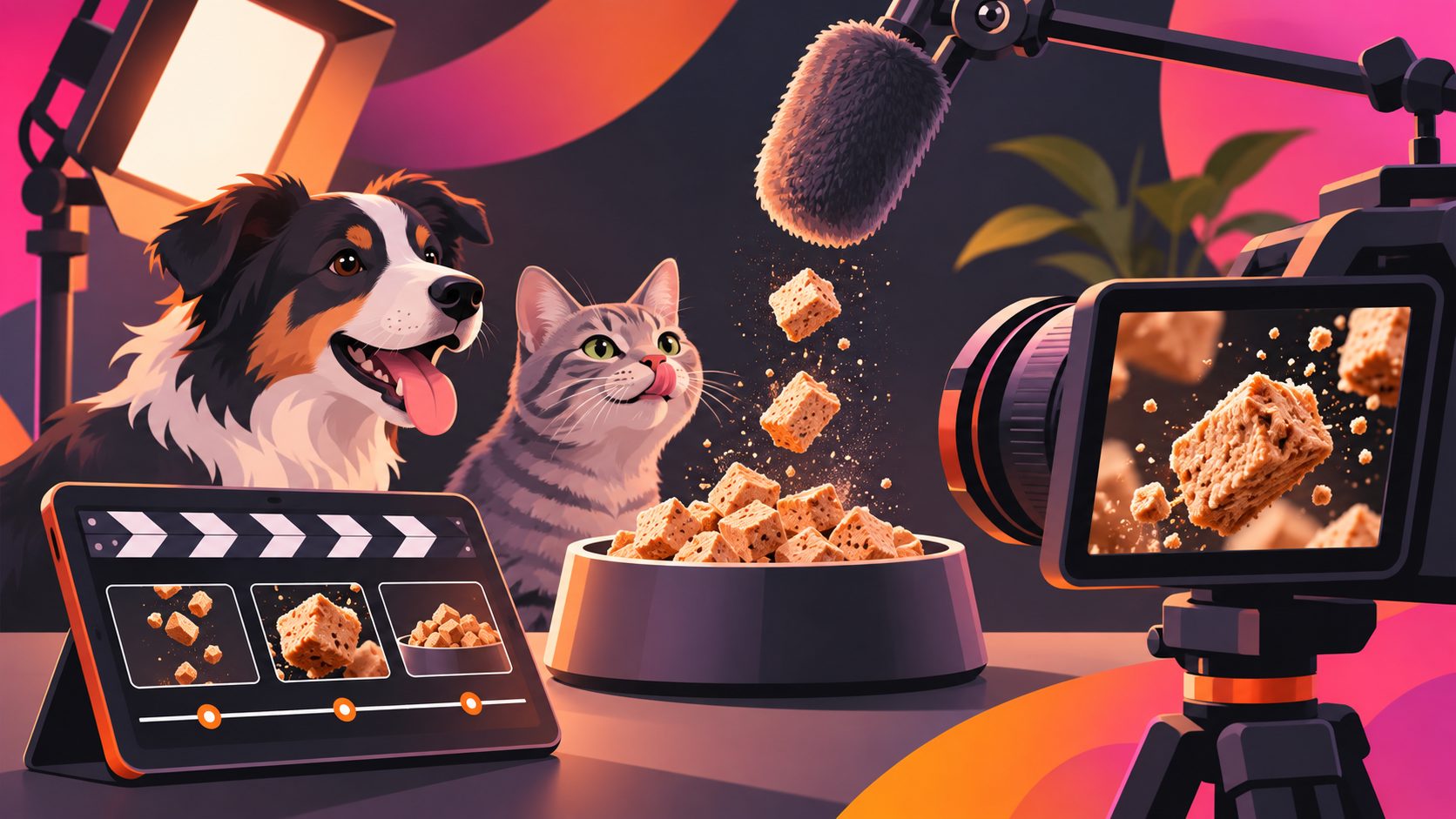
A freeze dried pet food ASMR ad uses enlarged food details and close-miked sounds to make the product feel tangible before the viewer ever opens the package. The creative goal is not simply “make it crunchy.” It is to connect visual proof, sound, and pet behavior in a short sequence.
Existing pet food advertising commonly uses three approaches:
- A recognizable pet-food commercial with a broad emotional promise.
- A creator-style testimonial focused on picky eating or bowl completion.
- A sensory ASMR treatment built around packaging, preparation, and chewing sounds.
For example, Petco’s “Ultimate Dog ASMR” campaign combined soft spoken narration with crackling and crunching sounds, while Freshpet used a repeated food-preparation “ritual” as a recognizable brand device. (thearf-org-unified-admin.s3.amazonaws.com)
The opportunity for freeze dried products is more specific: show the transformation from dry piece to real feeding moment. That gives the viewer a visual story rather than a collection of attractive food shots.
The three proof layers
- Product proof: shape, color, surface texture, package, and ingredient visibility.
- Sensory proof: snap, crumble, pour, water absorption, or bowl contact.
- Behavior proof: the pet approaches, sniffs, eats, or returns for another bite.
Avoid presenting a pet’s interest as proof of medical or nutritional superiority. Keep claims tied to what the video visibly demonstrates and what the product label supports.
A 15-second storyboard for macro texture and taste testing
The following storyboard is an original production framework built around a 15-second attention budget. It allocates time to the product before the pet appears, because a viewer should understand what is being tested before seeing the reaction.
| Time | Shot | Visual direction | Sound direction |
|---|---|---|---|
| 0.0–1.5s | Pattern interrupt | Drop one freeze dried piece onto a dark plate | Dry tap or snap |
| 1.5–3.5s | Macro reveal | Slow push-in across the surface and cut edge | Light package crinkle |
| 3.5–5.0s | Texture test | Break or press one piece near the lens | Amplified crack |
| 5.0–7.0s | Serving moment | Pour pieces into a clean bowl | Short cascade sound |
| 7.0–10.5s | Pet response | Capture approach, sniff, and first bite | Natural movement and chewing |
| 10.5–12.5s | Repeat bite | Show a second piece or bowl return | One clean crunch, not a sound wall |
| 12.5–15.0s | Product and CTA | Pack shot with one concise benefit or offer | Music resolves under CTA |
This structure improves the common “pet first, product later” format by placing the sensory promise upfront. It also gives editors multiple cut points for 6-second, 9-second, and 15-second placements.
A product-focused Amazon PPC video ad launch strategy can use the same structure, while a more social-first version should reserve safe space for captions and platform UI.
How to film the macro cutaway
Macro footage does not require an expensive studio, but it does require consistency. Use a stable phone or camera, a close-focusing lens, and a fixed surface that contrasts with the food.
Recommended setup
- Background: matte black, warm stone, or another non-reflective surface.
- Light: one large soft light from the side and a weaker fill from the opposite side.
- Camera movement: slow slider, controlled handheld push-in, or locked tripod shot.
- Frame rate: record the break, pour, and bite at a higher frame rate if you want to create a half-speed texture moment.
- Focus: lock focus before the food enters the frame.
- Color: keep the product’s natural color; excessive sharpening can make crumbs look artificial.
For a pale product, a darker background creates edge separation. For dark liver or meat pieces, use a lighter surface and a narrow rim light. The goal is to make the porous interior, irregular edges, and crumble visible without making the food look wet or greasy.
A useful production rule is one texture per shot. Do not combine a package crinkle, pouring sound, voiceover, music, and chewing in the same moment. A clean sound event is easier to notice and easier to reuse in multiple edits.
How to record convincing chewing ASMR
Chewing audio is difficult because room noise, bowl movement, and camera handling can overpower the actual bite. Record the product sounds separately from the pet footage whenever possible.
Practical audio workflow
- Record packaging, pouring, breaking, and bowl sounds in a quiet room.
- Place the microphone close to the action but outside the frame.
- Capture at least three takes of each sound.
- Film the pet’s eating reaction with natural audio as a separate track.
- Build the final mix with one dominant sound at a time.
- Add captions so the ad still works when muted.
Do not fake a dramatic crunch if the product naturally produces a softer sound. A believable crumble, bowl tap, or sniff can feel more trustworthy than an exaggerated effect.
ASMR is also a preference-sensitive format. Some viewers enjoy eating sounds, while others find them distracting. Create two versions: one with prominent chewing and one with restrained natural audio. The visual sequence can remain identical while the sound mix changes.
How to show a real palatability test without overclaiming
A short ad can show a taste test, but it cannot establish universal preference from one pet. Present the footage as an individual feeding moment rather than scientific evidence.
A responsible test card can include:
- Pet name or a neutral identifier.
- Species and approximate size.
- Whether the food was served dry or rehydrated.
- Whether the pet had seen the product before.
- The observation window, such as first approach or first bite.
- Any relevant feeding instructions from the product packaging.
Avoid claims such as “dogs love it,” “the healthiest option,” or “guaranteed to work” unless the brand has substantiation. A safer line is: “Watch our first-bite test.”
For products that can be served with water, show the preparation clearly and follow the manufacturer’s directions. Do not imply that a visual change proves improved nutrition or digestibility.
Turning one shoot into multiple ad variations
The highest-value improvement is not merely making one attractive video. It is designing the shoot so that one reference asset can produce a testing library.
Create variations across four dimensions:
- Hook: “Listen to that crunch,” “Picky eater test,” or “What does freeze dried texture look like?”
- Proof: macro cutaway, ingredient view, preparation step, or first bite.
- Pet: different size, breed, age, or creator context.
- CTA: shop the recipe, try a sample, view ingredients, or learn how to serve.
AdsTurbo supports product video creation from JPG or PNG product images, as well as ad cloning, subtitles, video translation, background replacement, AI upscaling, and character replacement. Its Ad Clone workflow can analyze a reference video up to 12 seconds and generate advertising variations, which is useful when a winning hook needs new product, language, or audience treatments.
For caption-led placements, TikTok safe-zone text guidance helps keep the macro product and CTA visible around interface overlays. For localized campaigns, AI Spanish UGC video generation provides a relevant workflow for adapting creator-style product ads.
A simple testing scorecard
Use a 1–5 score for each version across five dimensions:
| Metric | What to inspect |
|---|---|
| First-frame clarity | Can viewers identify the product in one second? |
| Texture interest | Does the macro shot show a distinct surface or cutaway? |
| Audio tolerance | Is the sound clear without becoming unpleasant? |
| Pet proof | Does the reaction feel natural and easy to understand? |
| CTA visibility | Can viewers read the next step without pausing? |
A strong candidate should score at least 4 on product clarity, texture interest, and CTA visibility before paid testing. This is an editorial benchmark, not a guaranteed performance threshold. Pair it with platform metrics such as thumb-stop rate, three-second views, hold rate, and add-to-cart rate.
The key information gain is the separation of sensory appeal from purchase proof. A crunchy close-up may earn attention, but the package, serving context, and transparent test framing are what help convert attention into confidence.
Common questions
Is ASMR suitable for freeze dried pet food ads?
Yes, when the product has a clear sensory feature such as a dry snap, crumble, pour, or bowl sound. Keep the mix restrained and provide captions or a non-chewing version for viewers who dislike eating audio.
Should the ad show the pet eating immediately?
Not always. A one- to two-second macro reveal before the pet appears gives viewers context and makes the feeding reaction easier to interpret.
Can a 15-second ad prove palatability?
No. It can document one pet’s observed response, but it cannot prove universal preference. Use careful language such as “first-bite test” or “our dog’s reaction.”
What aspect ratio should be used?
Create a vertical 9:16 master for short-form placements, then prepare square and landscape adaptations when the campaign also uses feeds, product pages, or display placements.
How can one video create more variants?
Separate the hook, product proof, pet reaction, language, captions, and CTA into editable components. This makes it easier to test creative variables without rebuilding every shot.