Freeze Dried Pet Food Taste Test Video Ads: 15-Second Scripts and Testing Framework

Summarize with
Summary
Build freeze dried pet food taste test video ads with a two-bowl blind test, 15-second scripts, proof-focused shots, and scalable creative testing. Start planning your next ad.
By adsturbo.ai | Published 2026-11-07 | Updated 2026-11-07
For DTC pet food brands, freeze dried pet food taste test video ads work best when the pet’s reaction is treated as evidence—not as a guaranteed claim. A controlled two-bowl setup, clear timing, and an uninterrupted eating moment can make a 15-second creative feel more credible, more watchable, and easier to test across TikTok, Meta, and YouTube Shorts.
What makes a freeze-dried pet food taste test ad persuasive?
A freeze-dried pet food taste test ad is a short product demonstration that shows an animal encountering, choosing, or eating the food under a simple visual test. The strongest version answers three buyer questions quickly: Will my pet show interest? What exactly is being served? Can I trust this reaction?
Search results commonly emphasize picky-eater hooks, ingredient close-ups, audible crunch, and a visible bowl-emptying moment. Some UGC examples also recommend an uninterrupted eating shot and repeating the meal on a second occasion to reduce the impression of a lucky take. (onecraft.app)
The information gap is that many scripts show a reaction without defining the test. A better creative separates attention, palatability signal, and purchase proof:
- Attention: the pet ignores, sniffs, or approaches the bowl.
- Palatability signal: the pet chooses one bowl or continues eating.
- Purchase proof: the pack, serving format, product detail, or offer appears clearly.
Do not frame one pet’s preference as proof that every animal will prefer the food. Avoid unsupported claims about health, digestion, allergies, or veterinary approval.
How should a two-bowl blind taste test be filmed?
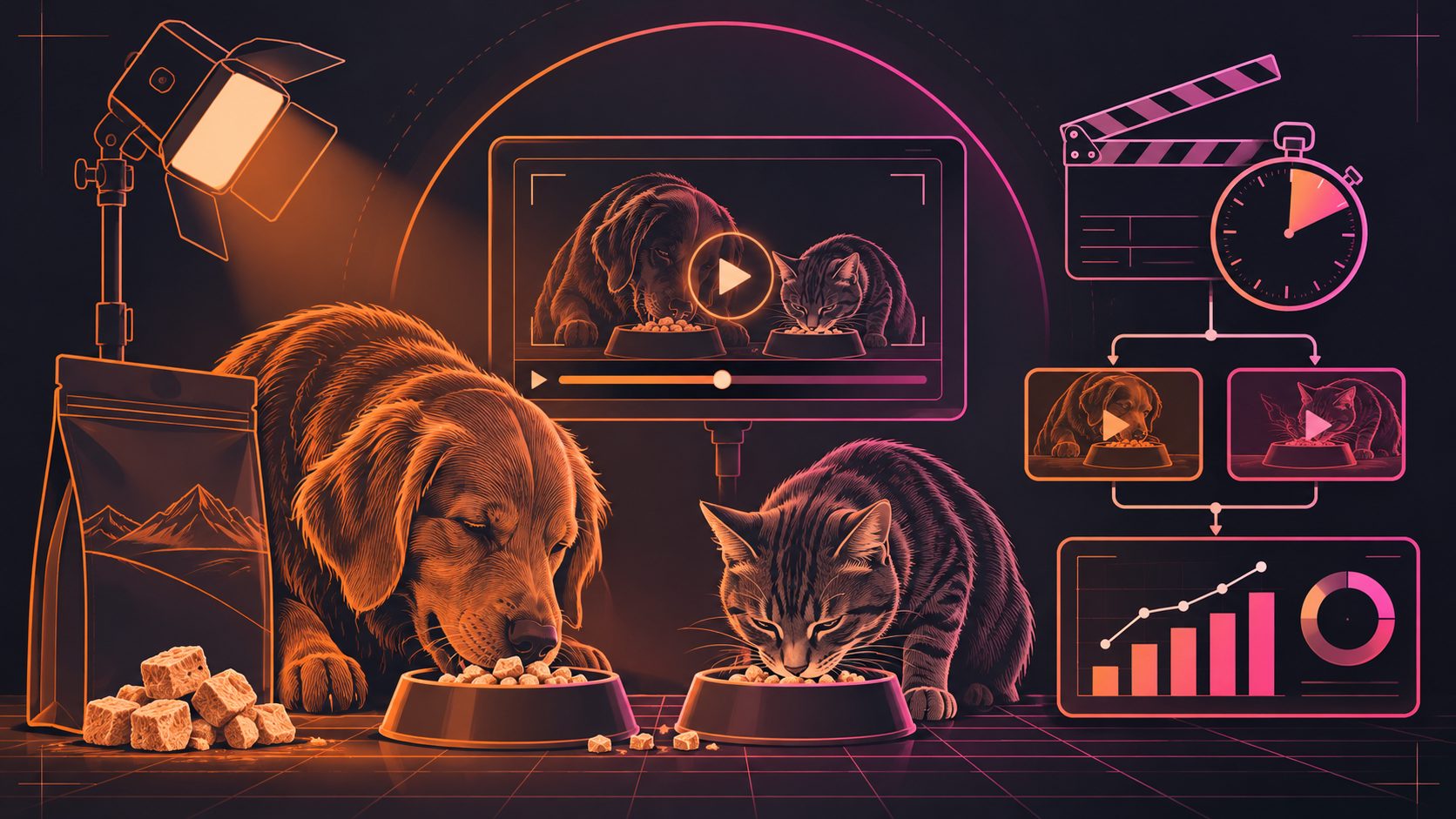
A two-bowl test should keep the variables visible and consistent: same bowl type, similar serving size, equal distance from the pet, and no verbal prompting during the choice. The goal is not to create a scientific nutrition study. It is to produce a transparent, repeatable creative that viewers can understand immediately.
Recommended setup
- Use two identical bowls placed at equal distance.
- Label them with neutral markers such as A and B.
- Keep the camera fixed before the pet enters the frame.
- Record the full approach, sniff, first bite, and continued eating.
- Avoid showing a competing brand package unless the comparison is legally cleared.
- Repeat the setup for a second meal if the claim depends on consistency.
- Add a visible timer only when it reflects the actual recording.
A practical creative test can include three opening hooks, two bowl layouts, and two edit lengths. That produces 12 variations from one filming session:
| Variable | Version A | Version B |
|---|---|---|
| Hook | “Which bowl will she choose?” | “He usually walks away from new food.” |
| Layout | Left/right bowls | Bowls switched between takes |
| Length | 15 seconds | 20–25 seconds |
| Proof moment | First bite | Continued eating plus pack shot |
This framework is an original testing structure for separating the effect of the hook from the effect of the pet reaction. If the same reaction performs differently under different openings, the first three seconds—not the product demonstration—may be the bottleneck.
What is a strong 15-second script structure?
A 15-second pet food ad should devote most of its runtime to the animal, not the founder’s explanation. A useful structure is 2 seconds of tension, 8 seconds of observable behavior, 3 seconds of product proof, and 2 seconds of action.
15-second blind taste test script
0:00–0:02 — Hook
On-screen text: “Two bowls. One first choice.”
Visual: Dog enters the frame and notices both bowls.
0:02–0:06 — Choice
Voice-over: “No calling her over. Let’s see which one she picks.”
Visual: Keep the camera running as the dog sniffs both bowls.
0:06–0:10 — Eating proof
Voice-over: none.
Visual: Show the first bite and at least several uninterrupted seconds of eating. Keep natural bowl and food sounds where possible.
0:10–0:13 — Product identification
Voice-over: “This is our freeze-dried [protein] recipe.”
Visual: Pack close-up, dry texture, serving size, or rehydration step.
0:13–0:15 — CTA
On-screen text: “See the recipe and feeding guide.”
Visual: Product plus landing-page action.
The CTA should match the evidence shown. If the video only demonstrates interest, use “See the recipe” or “Try a sample.” Do not jump from one taste test to an absolute promise.
For a more sensory angle, use a macro opening: package tear, pieces falling into the bowl, a close-up of texture, then the pet’s reaction. AdsTurbo’s freeze-dried pet food macro ASMR video plan is a useful companion format when the brand wants to test sound and texture before showing a full comparison.
Which hooks should DTC pet food brands test?
The best hook depends on the objection being tested. A picky-eater hook attracts problem-aware shoppers, while a blind-test hook creates curiosity. A texture hook is better suited to viewers who already understand freeze-dried food.
Test these as separate opening lines rather than combining them into one crowded intro:
- Picky eater: “She usually sniffs the bowl and walks away.”
- Blind test: “We switched the bowls. Can he still find his favorite?”
- Curiosity: “Two bowls, no cues, one first bite.”
- Sensory: “Turn the sound on for this crunch.”
- Routine: “Tonight’s dinner test took less than a minute.”
- Ingredient proof: “Single-protein freeze-dried food, served dry.”
- Second-meal proof: “The first reaction was interesting. This was dinner two.”
Keep claims narrow. “Finished the bowl” is an observation if the full sequence supports it. “Loves every meal” is a generalized claim that the footage cannot establish.
How can brands turn one taste test into multiple ads?
One recorded test can become a creative package instead of a single asset. Start with the original vertical video, then produce versions organized around different buyer concerns:
- Reaction cut: pet behavior first, minimal narration.
- Ingredient cut: product label, protein, texture, and serving format.
- Comparison cut: two bowls with neutral labels and no unsupported superiority claim.
- ASMR cut: package opening, pouring, crunch, and bowl movement.
- Localization cut: translated captions and voice-over for another market.
- Retargeting cut: product close-up, feeding instruction, and offer.
AdsTurbo supports product video generation from JPG or PNG product images, as well as video subtitles, translation, clip-by-clip editing, and product-focused creative workflows. Its subtitle tool can create timed captions and export either a captioned video or a separate subtitle file. These features are useful when the same test needs versions for TikTok, Instagram Reels, and YouTube Shorts.
For a broader production workflow, the ecommerce creative variation generator can help organize hook, proof, and offer variations without changing the central demonstration.
What should the creative scorecard measure?
Do not judge a taste-test ad only by click-through rate. A reaction may generate attention but fail to communicate what the product is. Use a simple scorecard across the first test batch:
| Metric | What it reveals |
|---|---|
| 3-second hold | Whether the opening creates immediate curiosity |
| 25% video view rate | Whether the test is easy to follow |
| Completion rate | Whether the proof moment earns attention |
| Landing-page view rate | Whether the CTA creates useful intent |
| Add-to-cart rate | Whether the product and offer are clear |
| Comment quality | Whether viewers ask about ingredients, serving, or price |
A useful decision rule is to keep the same pet reaction while changing only one variable at a time. If the hook changes, keep the edit and CTA stable. If the bowl layout changes, keep the opening line stable. This prevents a creative team from mistaking a stronger offer, better lighting, or a different animal take for a better concept.
AdsTurbo’s bulk AI video ad generation workflow is relevant when a brand has enough approved footage and wants to expand a controlled winner into multiple placements or language versions.
Common questions about pet food taste test ads
Is a two-bowl test scientifically conclusive?
No. It is a marketing demonstration of one animal’s observed preference under one set of conditions. Present the result as an individual reaction, not proof that the product is universally preferred.
Should the food be served dry or rehydrated?
Show the serving format the customer is expected to use. If both formats matter, create separate edits and explain the difference visually. Pet food guidance often recommends following the product’s feeding instructions and handling freeze-dried raw products carefully. (dogfoodadvisor.com)
Should a competitor appear in the video?
Not necessarily. Neutral bowls labeled A and B can communicate a comparison without creating packaging, trademark, or substantiation issues. If a named comparison is important, obtain legal and platform review before publishing.
Can AI generate the whole taste test?
AI can help create product visuals, captions, translations, variations, and edited ad structures. The most credible taste-test proof should come from footage that accurately represents the animal, product, and test conditions. Do not fabricate a reaction or imply a real-world result that did not occur.
What is the safest CTA?
Use a CTA tied to the demonstrated evidence: “See the ingredients,” “View feeding instructions,” “Try the recipe,” or “Shop the starter pack.” Avoid health promises unless the claim has appropriate substantiation and regulatory review.
Final takeaway
The most effective freeze dried pet food taste test video ads are not the loudest ones. They are the clearest: one visible test, one uninterrupted reaction, one product explanation, and one honest next step. Build the first batch around three hooks, two layouts, and two lengths, then use retention and purchase-intent signals to decide which story deserves more variations.